Influencer Marketing Platforms: Why Automation is Key for 2026
Influencer Marketing Platforms: Why Automation is Key for 2026
Jennifer Geithner •
December 17, 2025
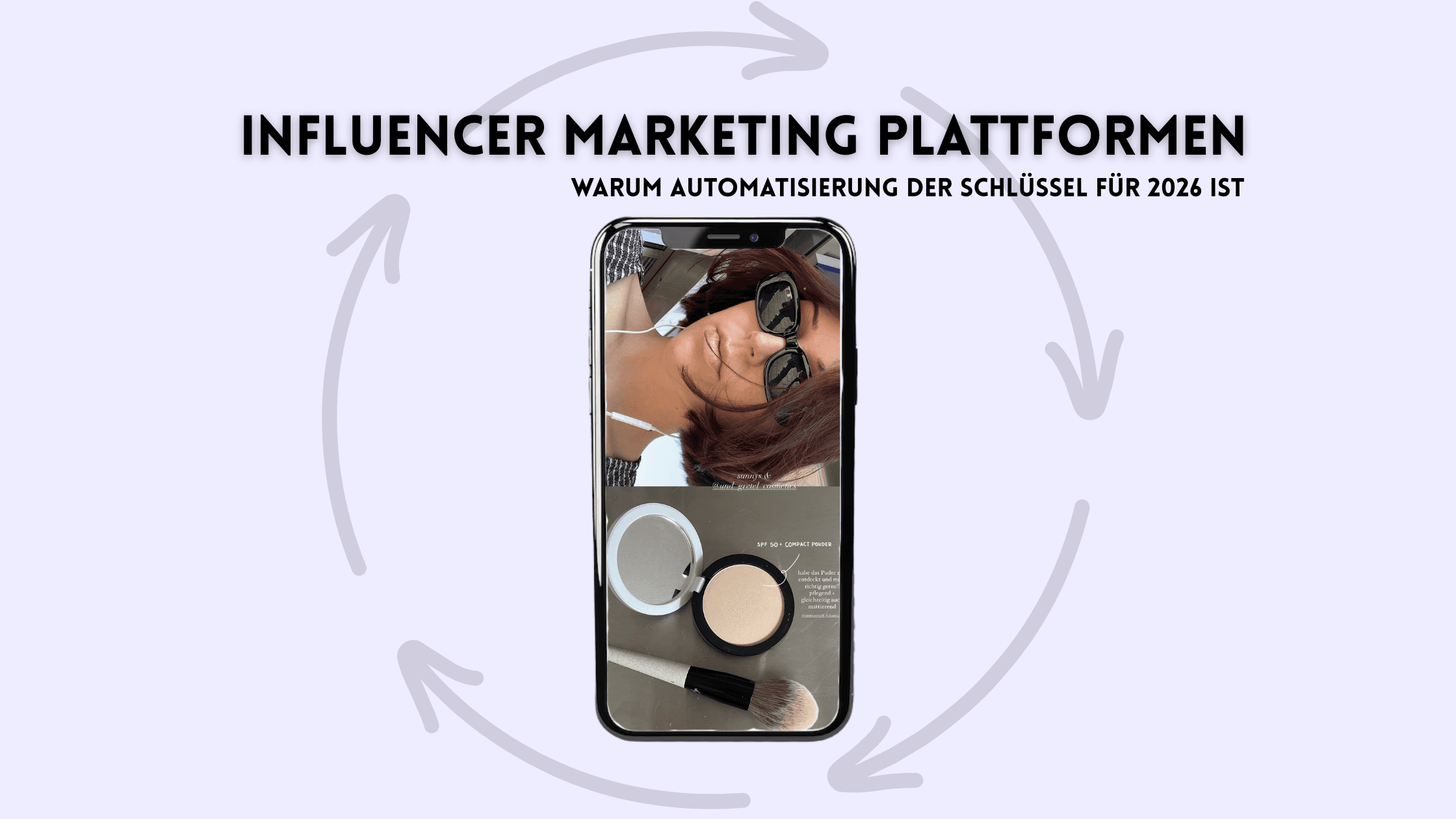
It’s 8:47 a.m. in the marketing department: three campaigns, five tools, ten open tabs. Everyone knows influencer marketing should run much faster today—but day-to-day work still feels painfully manual.
That’s exactly why automation has become so important. It makes sure briefings, matching, content, and reporting no longer run as separate mini-projects, but finally come together. As we see every day at Refluenced, the right platforms are already showing how powerful this effect can be.
This article explains why automation will be the decisive lever in 2026—and how modern influencer marketing platforms are changing the entire process.
Why Influencer Marketing Can No Longer Be Scaled Manually in 2026
Influencer marketing has reached a scale that no longer fits traditional workflows. Today’s campaigns aren’t linear: while one creator is still working on their first video, others are already testing new hooks, Spark Ads are running in parallel, trends are shifting by the hour—and the number of relevant creators keeps growing.
In this environment, problems rarely come from ideas. They come from processes:
Briefings that disappear somewhere in a Slack thread
Content scattered across DMs, email, and Drive
Insights that have to be cobbled together manually and arrive too late
KPIs that only become visible once most of the budget is already spent
These workflows come from a time when campaigns moved slower and teams were bigger. They simply don’t fit a market that reacts in real time.
The real bottleneck isn’t a lack of creativity—it’s a lack of structure. Teams struggle less with the “what” and more with the “how”:
How do you maintain oversight?
How do you spot early which creators are really working?
How do you run multiple campaigns in parallel without losing the thread?
And how do you make sure creators actually deliver what they’re supposed to?
Why Automation Will Be Crucial in 2026
The problem with influencer marketing in 2026 isn’t that the market is too fast—teams are used to that by now. The real problem is the sheer number of micro-decisions a campaign requires every single day:
Who gets approved?
Which version performs better?
Which creators communicate clearly?
What about usage rights?
Which content should be used for ads?
None of these tasks are hard on their own.
But taken together, they’re impossible to manage manually at scale.
Automation, therefore, isn’t just an “accelerator”—it’s a way to bring order. It doesn’t replace creative work; it reduces the number of decisions brands have to make in the first place. And that’s what changes influencer marketing in a way you only really grasp if you’ve managed campaigns yourself.
Transitions Are the Real Pain Points in Influencer Marketing
Manual workflows tend to break at the handoffs:
Different tools, different creators, different data sources—and endless transitions in between. Effective automation doesn’t just fix a single step; it fixes the transitions. That’s where mistakes happen, information gets lost, decisions are delayed, and coordination stalls.
A few examples:
Matching: Automation ensures only creators who truly fit the target audience and campaign goal enter the process.
Content: Automated flows reduce the risk of duplicate versions, missing approvals, or unclear asset statuses.
Performance: Insights don’t show up as static reports at the end, but as they emerge—so you can adjust before budget is wasted.
Campaign management: Routine tasks simply disappear from the daily workload because the platform quietly handles them in the background.
Automation doesn’t just replace manual work—it bundles steps that used to be repeated 100 times into a single, clear process:
Automated briefing: One briefing for all creators—instead of countless PDFs that have to be sent, updated, and versioned by hand.
Automated contract logic: One central campaign contract that applies to everyone—no individual negotiations, no Excel chaos, no document flood.
Automated payments: One payment per campaign—instead of 100 separate transfers, invoices, or payment chases.
Automated creator data: Addresses, delivery info, and profile details flow directly into the system—no more one-off queries, everything lives in the platform.
And that’s where the real value shows up: automation doesn’t just remove tasks. It removes friction and allows brands to truly scale. In the same amount of time, you can work with more creators, produce more content, and measure results much more precisely.
Automation keeps creator relationships running smoothly, reduces time spent searching for information, makes results visible earlier, and makes campaigns feel more logical. For marketing teams, that means more control over what actually matters.
In short: in 2026, automation is the answer to an environment that’s becoming faster and more complex at the same time.
How Refluenced Implements Automation
Refluenced focuses on the parts of influencer marketing that eat up the most time in day-to-day work. The platform combines briefing, matching, content, rights, and performance into one streamlined process that’s clearly structured and works without extra tools. AI is used systematically, especially in campaign briefing—where it creates the biggest leverage.
A Precise Starting Point and a Setup You Only Have to Do Once
Every campaign in Refluenced starts with just a few inputs: goals, platform, desired assets, tone. From there, the platform generates a complete, AI-powered briefing that’s logically structured and ready to use.
The big advantage: you don’t just create the briefing once—you also handle all core tasks centrally, instead of individually for each creator.
One campaign contract instead of 20–100 individual negotiations
One unified payment instead of dozens of one-off payments
Addresses and creator data entered once, not repeatedly for each creator
All specs, deadlines, and assets in one place instead of scattered across threads
That creates a starting point that’s not only faster, but also more stable, because teams don’t have to duplicate work and creators get clear information from day one.
Matching that Improves the Process
Instead of searching for creators manually, brands receive applications from influencers who already match the target audience, style, and requirements. The platform evaluates relevant factors so the creator pool naturally improves over time—without anyone maintaining lists or filtering in spreadsheets.
Content & Rights in One Place
Once creators deliver, all assets automatically flow into a central workflow. Versions, approvals, rights, and final files stay organized, up to date, and accessible at any time. Teams don’t have to chase files, request updates, or track content across chats and drives.
Performance that Creates Clarity During the Campaign
Refluenced shows which content and creators are performing. The data updates automatically and allows for optimizations while they still move the needle. Strong posts can be scaled seamlessly via Partnership and Spark Ads.
Why This Makes Everyday Life So Much Easier
Refluenced uses automation to remove complexity. The result is a workflow that feels like one continuous process:
No tool switching
No file hunting
No loose ends
No surprises
No chaos
Just a clear flow that lets brands run campaigns faster, smoother, and more deliberately. Automation becomes something you can feel.
How Automation Is Changing Influencer Marketing in the Long Term
Influencer marketing is shifting away from isolated campaigns toward a system that continuously learns, optimizes, and evolves. Automated platforms spot patterns earlier, process creator signals faster, and make campaigns more predictable.
Content is becoming more modular: a single video can play multiple roles—perform as an organic post, power paid media, serve in A/B tests, or act as a template for other creators. Rights and data structures make this reuse much easier.
At the same time, the focus of teams is shifting. Operational tasks become less important, while strategy, creative direction, and creator partnerships become the main levers where brands can really stand out.
Automation is leading to influencer marketing that reacts more flexibly, delivers clean data, and surfaces actionable insights faster—an environment where decisions become clearer and campaigns rest on a more stable foundation.
FAQs
What Specific Advantages Does Automation Offer Brands?
Automation reduces operational effort and creates reliable, repeatable processes: briefings are ready faster, creator fit improves, content is stored in a structured way in one place, and performance data updates automatically. Teams make decisions on a solid basis and win back time for strategy.
How Does Automation via Influencer Marketing Platforms Support Collaboration with Creators?
Automated processes ensure transparent workflows and clear expectations. Briefings, feedback, and approvals stay traceable, so creators can produce faster and brands can manage them more confidently. Coordination turns into collaboration that feels professional and easy.
Which Areas Can Be Automated in Influencer Marketing Platforms?
Modern platforms like Refluenced primarily automate recurring steps: AI-generated briefings, an application-based process for suitable creators, a central content and rights workflow, and real-time performance tracking. The result: campaigns that are clearly structured and easy to scale.
Conclusion
Influencer marketing isn’t getting simpler—but it is getting smarter as automation takes over more of the process. Once you’ve experienced a campaign without constant tool switching, file hunting, and copy-paste work, the difference is obvious.
If you want to see how easy influencer marketing can feel in 2026, create a campaign in Refluenced and watch how the process changes. You’ll notice the difference from the very first setup.
It’s 8:47 a.m. in the marketing department: three campaigns, five tools, ten open tabs. Everyone knows influencer marketing should run much faster today—but day-to-day work still feels painfully manual.
That’s exactly why automation has become so important. It makes sure briefings, matching, content, and reporting no longer run as separate mini-projects, but finally come together. As we see every day at Refluenced, the right platforms are already showing how powerful this effect can be.
This article explains why automation will be the decisive lever in 2026—and how modern influencer marketing platforms are changing the entire process.
Why Influencer Marketing Can No Longer Be Scaled Manually in 2026
Influencer marketing has reached a scale that no longer fits traditional workflows. Today’s campaigns aren’t linear: while one creator is still working on their first video, others are already testing new hooks, Spark Ads are running in parallel, trends are shifting by the hour—and the number of relevant creators keeps growing.
In this environment, problems rarely come from ideas. They come from processes:
Briefings that disappear somewhere in a Slack thread
Content scattered across DMs, email, and Drive
Insights that have to be cobbled together manually and arrive too late
KPIs that only become visible once most of the budget is already spent
These workflows come from a time when campaigns moved slower and teams were bigger. They simply don’t fit a market that reacts in real time.
The real bottleneck isn’t a lack of creativity—it’s a lack of structure. Teams struggle less with the “what” and more with the “how”:
How do you maintain oversight?
How do you spot early which creators are really working?
How do you run multiple campaigns in parallel without losing the thread?
And how do you make sure creators actually deliver what they’re supposed to?
Why Automation Will Be Crucial in 2026
The problem with influencer marketing in 2026 isn’t that the market is too fast—teams are used to that by now. The real problem is the sheer number of micro-decisions a campaign requires every single day:
Who gets approved?
Which version performs better?
Which creators communicate clearly?
What about usage rights?
Which content should be used for ads?
None of these tasks are hard on their own.
But taken together, they’re impossible to manage manually at scale.
Automation, therefore, isn’t just an “accelerator”—it’s a way to bring order. It doesn’t replace creative work; it reduces the number of decisions brands have to make in the first place. And that’s what changes influencer marketing in a way you only really grasp if you’ve managed campaigns yourself.
Transitions Are the Real Pain Points in Influencer Marketing
Manual workflows tend to break at the handoffs:
Different tools, different creators, different data sources—and endless transitions in between. Effective automation doesn’t just fix a single step; it fixes the transitions. That’s where mistakes happen, information gets lost, decisions are delayed, and coordination stalls.
A few examples:
Matching: Automation ensures only creators who truly fit the target audience and campaign goal enter the process.
Content: Automated flows reduce the risk of duplicate versions, missing approvals, or unclear asset statuses.
Performance: Insights don’t show up as static reports at the end, but as they emerge—so you can adjust before budget is wasted.
Campaign management: Routine tasks simply disappear from the daily workload because the platform quietly handles them in the background.
Automation doesn’t just replace manual work—it bundles steps that used to be repeated 100 times into a single, clear process:
Automated briefing: One briefing for all creators—instead of countless PDFs that have to be sent, updated, and versioned by hand.
Automated contract logic: One central campaign contract that applies to everyone—no individual negotiations, no Excel chaos, no document flood.
Automated payments: One payment per campaign—instead of 100 separate transfers, invoices, or payment chases.
Automated creator data: Addresses, delivery info, and profile details flow directly into the system—no more one-off queries, everything lives in the platform.
And that’s where the real value shows up: automation doesn’t just remove tasks. It removes friction and allows brands to truly scale. In the same amount of time, you can work with more creators, produce more content, and measure results much more precisely.
Automation keeps creator relationships running smoothly, reduces time spent searching for information, makes results visible earlier, and makes campaigns feel more logical. For marketing teams, that means more control over what actually matters.
In short: in 2026, automation is the answer to an environment that’s becoming faster and more complex at the same time.
How Refluenced Implements Automation
Refluenced focuses on the parts of influencer marketing that eat up the most time in day-to-day work. The platform combines briefing, matching, content, rights, and performance into one streamlined process that’s clearly structured and works without extra tools. AI is used systematically, especially in campaign briefing—where it creates the biggest leverage.
A Precise Starting Point and a Setup You Only Have to Do Once
Every campaign in Refluenced starts with just a few inputs: goals, platform, desired assets, tone. From there, the platform generates a complete, AI-powered briefing that’s logically structured and ready to use.
The big advantage: you don’t just create the briefing once—you also handle all core tasks centrally, instead of individually for each creator.
One campaign contract instead of 20–100 individual negotiations
One unified payment instead of dozens of one-off payments
Addresses and creator data entered once, not repeatedly for each creator
All specs, deadlines, and assets in one place instead of scattered across threads
That creates a starting point that’s not only faster, but also more stable, because teams don’t have to duplicate work and creators get clear information from day one.
Matching that Improves the Process
Instead of searching for creators manually, brands receive applications from influencers who already match the target audience, style, and requirements. The platform evaluates relevant factors so the creator pool naturally improves over time—without anyone maintaining lists or filtering in spreadsheets.
Content & Rights in One Place
Once creators deliver, all assets automatically flow into a central workflow. Versions, approvals, rights, and final files stay organized, up to date, and accessible at any time. Teams don’t have to chase files, request updates, or track content across chats and drives.
Performance that Creates Clarity During the Campaign
Refluenced shows which content and creators are performing. The data updates automatically and allows for optimizations while they still move the needle. Strong posts can be scaled seamlessly via Partnership and Spark Ads.
Why This Makes Everyday Life So Much Easier
Refluenced uses automation to remove complexity. The result is a workflow that feels like one continuous process:
No tool switching
No file hunting
No loose ends
No surprises
No chaos
Just a clear flow that lets brands run campaigns faster, smoother, and more deliberately. Automation becomes something you can feel.
How Automation Is Changing Influencer Marketing in the Long Term
Influencer marketing is shifting away from isolated campaigns toward a system that continuously learns, optimizes, and evolves. Automated platforms spot patterns earlier, process creator signals faster, and make campaigns more predictable.
Content is becoming more modular: a single video can play multiple roles—perform as an organic post, power paid media, serve in A/B tests, or act as a template for other creators. Rights and data structures make this reuse much easier.
At the same time, the focus of teams is shifting. Operational tasks become less important, while strategy, creative direction, and creator partnerships become the main levers where brands can really stand out.
Automation is leading to influencer marketing that reacts more flexibly, delivers clean data, and surfaces actionable insights faster—an environment where decisions become clearer and campaigns rest on a more stable foundation.
FAQs
What Specific Advantages Does Automation Offer Brands?
Automation reduces operational effort and creates reliable, repeatable processes: briefings are ready faster, creator fit improves, content is stored in a structured way in one place, and performance data updates automatically. Teams make decisions on a solid basis and win back time for strategy.
How Does Automation via Influencer Marketing Platforms Support Collaboration with Creators?
Automated processes ensure transparent workflows and clear expectations. Briefings, feedback, and approvals stay traceable, so creators can produce faster and brands can manage them more confidently. Coordination turns into collaboration that feels professional and easy.
Which Areas Can Be Automated in Influencer Marketing Platforms?
Modern platforms like Refluenced primarily automate recurring steps: AI-generated briefings, an application-based process for suitable creators, a central content and rights workflow, and real-time performance tracking. The result: campaigns that are clearly structured and easy to scale.
Conclusion
Influencer marketing isn’t getting simpler—but it is getting smarter as automation takes over more of the process. Once you’ve experienced a campaign without constant tool switching, file hunting, and copy-paste work, the difference is obvious.
If you want to see how easy influencer marketing can feel in 2026, create a campaign in Refluenced and watch how the process changes. You’ll notice the difference from the very first setup.
It’s 8:47 a.m. in the marketing department: three campaigns, five tools, ten open tabs. Everyone knows influencer marketing should run much faster today—but day-to-day work still feels painfully manual.
That’s exactly why automation has become so important. It makes sure briefings, matching, content, and reporting no longer run as separate mini-projects, but finally come together. As we see every day at Refluenced, the right platforms are already showing how powerful this effect can be.
This article explains why automation will be the decisive lever in 2026—and how modern influencer marketing platforms are changing the entire process.
Why Influencer Marketing Can No Longer Be Scaled Manually in 2026
Influencer marketing has reached a scale that no longer fits traditional workflows. Today’s campaigns aren’t linear: while one creator is still working on their first video, others are already testing new hooks, Spark Ads are running in parallel, trends are shifting by the hour—and the number of relevant creators keeps growing.
In this environment, problems rarely come from ideas. They come from processes:
Briefings that disappear somewhere in a Slack thread
Content scattered across DMs, email, and Drive
Insights that have to be cobbled together manually and arrive too late
KPIs that only become visible once most of the budget is already spent
These workflows come from a time when campaigns moved slower and teams were bigger. They simply don’t fit a market that reacts in real time.
The real bottleneck isn’t a lack of creativity—it’s a lack of structure. Teams struggle less with the “what” and more with the “how”:
How do you maintain oversight?
How do you spot early which creators are really working?
How do you run multiple campaigns in parallel without losing the thread?
And how do you make sure creators actually deliver what they’re supposed to?
Why Automation Will Be Crucial in 2026
The problem with influencer marketing in 2026 isn’t that the market is too fast—teams are used to that by now. The real problem is the sheer number of micro-decisions a campaign requires every single day:
Who gets approved?
Which version performs better?
Which creators communicate clearly?
What about usage rights?
Which content should be used for ads?
None of these tasks are hard on their own.
But taken together, they’re impossible to manage manually at scale.
Automation, therefore, isn’t just an “accelerator”—it’s a way to bring order. It doesn’t replace creative work; it reduces the number of decisions brands have to make in the first place. And that’s what changes influencer marketing in a way you only really grasp if you’ve managed campaigns yourself.
Transitions Are the Real Pain Points in Influencer Marketing
Manual workflows tend to break at the handoffs:
Different tools, different creators, different data sources—and endless transitions in between. Effective automation doesn’t just fix a single step; it fixes the transitions. That’s where mistakes happen, information gets lost, decisions are delayed, and coordination stalls.
A few examples:
Matching: Automation ensures only creators who truly fit the target audience and campaign goal enter the process.
Content: Automated flows reduce the risk of duplicate versions, missing approvals, or unclear asset statuses.
Performance: Insights don’t show up as static reports at the end, but as they emerge—so you can adjust before budget is wasted.
Campaign management: Routine tasks simply disappear from the daily workload because the platform quietly handles them in the background.
Automation doesn’t just replace manual work—it bundles steps that used to be repeated 100 times into a single, clear process:
Automated briefing: One briefing for all creators—instead of countless PDFs that have to be sent, updated, and versioned by hand.
Automated contract logic: One central campaign contract that applies to everyone—no individual negotiations, no Excel chaos, no document flood.
Automated payments: One payment per campaign—instead of 100 separate transfers, invoices, or payment chases.
Automated creator data: Addresses, delivery info, and profile details flow directly into the system—no more one-off queries, everything lives in the platform.
And that’s where the real value shows up: automation doesn’t just remove tasks. It removes friction and allows brands to truly scale. In the same amount of time, you can work with more creators, produce more content, and measure results much more precisely.
Automation keeps creator relationships running smoothly, reduces time spent searching for information, makes results visible earlier, and makes campaigns feel more logical. For marketing teams, that means more control over what actually matters.
In short: in 2026, automation is the answer to an environment that’s becoming faster and more complex at the same time.
How Refluenced Implements Automation
Refluenced focuses on the parts of influencer marketing that eat up the most time in day-to-day work. The platform combines briefing, matching, content, rights, and performance into one streamlined process that’s clearly structured and works without extra tools. AI is used systematically, especially in campaign briefing—where it creates the biggest leverage.
A Precise Starting Point and a Setup You Only Have to Do Once
Every campaign in Refluenced starts with just a few inputs: goals, platform, desired assets, tone. From there, the platform generates a complete, AI-powered briefing that’s logically structured and ready to use.
The big advantage: you don’t just create the briefing once—you also handle all core tasks centrally, instead of individually for each creator.
One campaign contract instead of 20–100 individual negotiations
One unified payment instead of dozens of one-off payments
Addresses and creator data entered once, not repeatedly for each creator
All specs, deadlines, and assets in one place instead of scattered across threads
That creates a starting point that’s not only faster, but also more stable, because teams don’t have to duplicate work and creators get clear information from day one.
Matching that Improves the Process
Instead of searching for creators manually, brands receive applications from influencers who already match the target audience, style, and requirements. The platform evaluates relevant factors so the creator pool naturally improves over time—without anyone maintaining lists or filtering in spreadsheets.
Content & Rights in One Place
Once creators deliver, all assets automatically flow into a central workflow. Versions, approvals, rights, and final files stay organized, up to date, and accessible at any time. Teams don’t have to chase files, request updates, or track content across chats and drives.
Performance that Creates Clarity During the Campaign
Refluenced shows which content and creators are performing. The data updates automatically and allows for optimizations while they still move the needle. Strong posts can be scaled seamlessly via Partnership and Spark Ads.
Why This Makes Everyday Life So Much Easier
Refluenced uses automation to remove complexity. The result is a workflow that feels like one continuous process:
No tool switching
No file hunting
No loose ends
No surprises
No chaos
Just a clear flow that lets brands run campaigns faster, smoother, and more deliberately. Automation becomes something you can feel.
How Automation Is Changing Influencer Marketing in the Long Term
Influencer marketing is shifting away from isolated campaigns toward a system that continuously learns, optimizes, and evolves. Automated platforms spot patterns earlier, process creator signals faster, and make campaigns more predictable.
Content is becoming more modular: a single video can play multiple roles—perform as an organic post, power paid media, serve in A/B tests, or act as a template for other creators. Rights and data structures make this reuse much easier.
At the same time, the focus of teams is shifting. Operational tasks become less important, while strategy, creative direction, and creator partnerships become the main levers where brands can really stand out.
Automation is leading to influencer marketing that reacts more flexibly, delivers clean data, and surfaces actionable insights faster—an environment where decisions become clearer and campaigns rest on a more stable foundation.
FAQs
What Specific Advantages Does Automation Offer Brands?
Automation reduces operational effort and creates reliable, repeatable processes: briefings are ready faster, creator fit improves, content is stored in a structured way in one place, and performance data updates automatically. Teams make decisions on a solid basis and win back time for strategy.
How Does Automation via Influencer Marketing Platforms Support Collaboration with Creators?
Automated processes ensure transparent workflows and clear expectations. Briefings, feedback, and approvals stay traceable, so creators can produce faster and brands can manage them more confidently. Coordination turns into collaboration that feels professional and easy.
Which Areas Can Be Automated in Influencer Marketing Platforms?
Modern platforms like Refluenced primarily automate recurring steps: AI-generated briefings, an application-based process for suitable creators, a central content and rights workflow, and real-time performance tracking. The result: campaigns that are clearly structured and easy to scale.
Conclusion
Influencer marketing isn’t getting simpler—but it is getting smarter as automation takes over more of the process. Once you’ve experienced a campaign without constant tool switching, file hunting, and copy-paste work, the difference is obvious.
If you want to see how easy influencer marketing can feel in 2026, create a campaign in Refluenced and watch how the process changes. You’ll notice the difference from the very first setup.
Table of Content
Label
Share It On
Share It On
Share It On
